
CHICAGO’S INTERNATIONAL MUSEUM OF SURGICAL SCIENCE CELEBRATES ITS 72ND BIRTHDAY WITH THE CREATURE FROM THE BLACK LAGOON
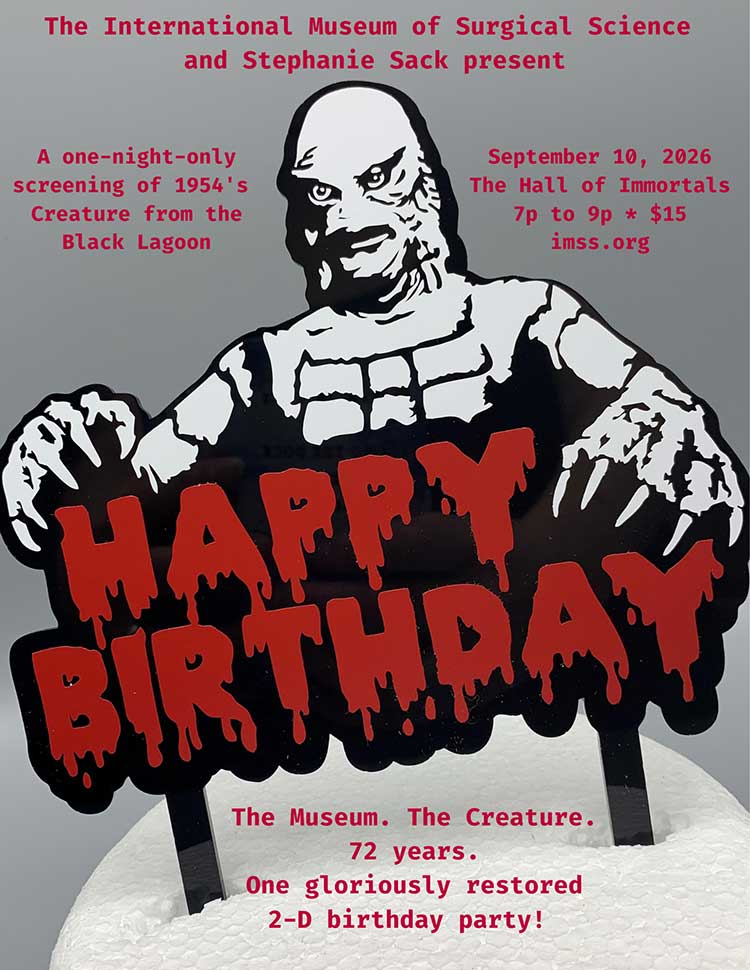
EVENT DETAILS
CREATURE FROM THE BLACK LAGOON (1954)
B&W, 2-D presentation
Thursday, September 10, 2026
Doors: 6:30p
Screening: 7:00p
Tickets are limited to ONLY 50 attendees and are available at https://www.eventbrite.com/e/film-screening-creature-of-the-black-lagoon-tickets-1997635059237?aff=oddtdtcreator&keep_tld=true.
- $15 GA Presale
- $10 Student Presale (Use code STUDENT at checkout)
- $10 IMSS Member Presale (Use code IMSSMEMBER at checkout)
At Door
- $20 at Door
- $15 Student at Door
- $15 IMSS Member at Door
International Museum of Surgical Science
Hall of Immortals
1524 N. Lake Shore Drive
Chicago, Illinois
GILLINOIS WELCOMES HOME THE CREATURE:
CHICAGO’S INTERNATIONAL MUSEUM OF SURGICAL SCIENCE CELEBRATES ITS 72ND BIRTHDAY WITH
CREATURE FROM THE BLACK LAGOON
On September 10, 2026, the Gillman returns for an intimate, one-night-only screening
of Universal’s 1954 black and white classic in beautifully restored digital 2-D
CHICAGO, GILLINOIS , August 11, 2026 — On September 9, 2026, Chicago’s International Museum of Surgical Science is turning 72 — and it is celebrating this milestone in tandem with another remarkable entity from the Class of 1954.
On Thursday, September 10, join Chicago film curator Stephanie Sack in the Museum’s Hall of Immortals for an intimate, one-night-only presentation of Jack Arnold’s Creature from the Black Lagoon (1954), as GILLINOIS welcomes home the Gillman for his and the Museum’s 72nd birthday party.
And this is a birthday the two were almost destined to share.
The International Museum of Surgical Science opened its doors to the public on September 9, 1954. Earlier that same year, Universal introduced moviegoers to another extraordinary specimen: the Gillman.
The Museum opened in 1954. The Creature surfaced in 1954.
Seventy-two years later, they are spending their birthday together in the Hall of Immortals.
The setting could hardly be more appropriate.
Occupying a singular place in movie history as the last great original addition to Universal’s classic monster pantheon, the Gillman arrived after Dracula, Frankenstein’s Monster, the Mummy, and the Wolf Man had already emerged from the Gothic nightmares of earlier decades.
The Creature belonged to a different age. He wasn’t supernatural. He wasn’t resurrected. He wasn’t cursed.
He was biological.
Discovered by scientists and presented as a living evolutionary mystery, the Gillman is a monster conceived through anatomy itself. He is bipedal, with paired limbs, articulated hands, forward-facing eyes, and an unmistakably humanoid body plan. Yet dermal scales, webbed extremities, dorsal fins, and functional gills place that familiar form within an entirely different biological order.
Much of this resulting unease came from artist Milicent Patrick. Her exacting design makes the Gillman disturbing not because he is wholly alien, but because he remains tantalizingly recognizable. The human body is still there beneath the amphibious adaptation, close enough to identify but impossible to classify. The horror lies partly in our inability to decide exactly where the human ends.
Which makes the International Museum of Surgical Science an almost absurdly perfect place to encounter him.
In a museum devoted to anatomy, medicine, and humanity’s centuries-long effort to understand the body, Creature from the Black Lagoon poses a wonderfully uncomfortable question:
What happens when science discovers a body it cannot classify?
The scientists in the film want to observe the Creature, study him, understand him — and inevitably possess him. The Gillman becomes not simply a monster, but a specimen: a living challenge to the boundaries between human and animal, ancient and modern, discovery and intrusion.
He also arrived during one of the great years in monster history.
In 1954, two radically different creatures surfaced on opposite sides of the Pacific. Japan gave the atomic age Godzilla, a towering nightmare manifested from the darkness of nuclear destruction. America gave it a strange biological sibling: the Gillman, an ancient survivor thrust into the modern world by scientific curiosity.
One embodied the terror of what humanity had created. The other asked what might already be waiting for us to discover.
And when the Gillman first arrived, he arrived with a bang.
Creature from the Black Lagoon was shot in black-and-white 3-D, a sensational format for introducing a monster whose world existed beneath the surface. The Creature could swim toward the audience, reach into the theater and seemingly collapse the distance between his lagoon and the movie house.
It was a fantastic way to meet him — but it was far from the only way.
For generations of monster kids, and particularly for generations of Chicago monster kids , the Gillman was encountered in 2-D: on neighborhood screens, school events, and, perhaps most memorably, on television.
No glasses. No equipment. No gimmicks. Just the Creature.
By the 1970s, the Gillman was already swimming through Chicago’s extraordinary tradition of locally presented horror movies. Creature from the Black Lagoon appeared on WGN-TV Channel 9’s Creature Features, including a Saturday-night broadcast on May 31, 1975.
And in a bit of Chicago television history almost too perfect for this movie, WGN’s Creature Features did not rely on an on-camera horror host. The films were introduced by an eerie, disembodied voice known simply as “The Creature,” voiced first by longtime WGN announcer Carl Greyson and later by WGN newsman Marty McNeeley.
By the era in which Gillman was appearing on the program, McNeeley was the voice of The Creature.
The Creature introducing the Creature. On WGN. In Chicago.
The Gillman later migrated into another beloved Chicago monster tradition. Creature from the Black Lagoon can be documented on Rich Koz’s legendary Son of Svengoolie on WFLD Channel 32 by May 10, 1980, beginning another chapter in the long relationship between Chicago television and Universal’s amphibious monster.
“As a daughter of Chicago with a lifelong affection for creature features, television is where I first encountered the Gillman,” says Sack. “There is something very Chicago about growing up with these monsters coming into your house on local TV. So bringing the Creature back to the big screen, in the Hall of Immortals, for the birthday of a museum that entered the world the same year he did feels wonderfully full-circle.”
That history is also part of why the September 10 screening will be presented in beautifully restored digital 2-D.
Certainly, the film’s original format deserves its place in movie history. Creature from the Black Lagoon was photographed in black-and-white 3-D, and Chicago audiences have continued to experience the Gillman stereoscopically across generations, from a rare 35mm 3-D presentation at the Patio Theatre in 2013, with star Julie Adams herself in attendance, to a 3-D screening at the University of Chicago’s Doc Films as recently as 2024.
This evening at the Museum, however, celebrates another equally important part of the Creature’s afterlife: the Gillman generations of viewers first encountered in 2-D, flattened onto television screens in frunchrooms across Chicago. No flimsy glasses, complicated equipment, or added spectacle were necessary. The Creature was unforgettable all by himself.
Except this time, the television is gone. This is a small screening, for a small audience, inside one of Chicago’s most extraordinary rooms.
The Gillman slithers out of the television set to come ashore in GILLINOIS.
Guests will gather as daylight begins to disappear over the city. As the sun goes down, the Hall of Immortals will slowly be bathed in an eerie green glow, transforming the room into a temporary lagoon for the evening’s screening.
And seventy-two years after the Museum opened its doors and the Creature first surfaced, they finally celebrate their shared birthday together in the Hall of Immortals.





Leave a Reply
You must be logged in to post a comment.